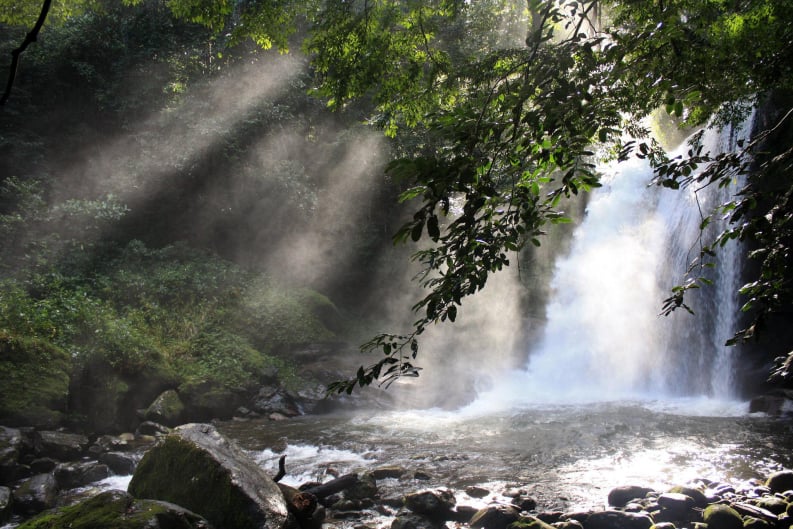
Udzungwa Mountains
A single-day immersion into one of Africa's most biodiverse rainforests — ancient mountains teeming with endemic primates, rare birds, and the thundering Sanje Waterfalls cascading through a canopy found nowhere else on earth.
The Udzungwa Mountains form part of the Eastern Arc Mountains — an ancient chain of forest-covered ranges stretching from Kenya to Tanzania, regarded by scientists as one of the world's top biodiversity hotspots. The Udzungwa Mountains National Park protects the largest and least-disturbed block of these forests, sheltering an extraordinary number of endemic species found nowhere else on the planet: the Sanje mangabey, the Udzungwa red colobus, the Udzungwa partridge, and dozens of endemic plants, amphibians, and insects.
The most popular day hike follows the Sanje Waterfall Trail — a well-marked route through dense lowland rainforest that climbs steadily to the base of the lower Sanje Falls (170m), with the option to push further to the upper falls for a broader panorama over the forest canopy and the Kilombero Valley plains below. The trail is rich in wildlife from the first steps: troops of red colobus and Angolan colobus move through the canopy overhead, and the forest floor is laced with streams and carpeted in mosses and ferns.
This is a day hike departing from Dar es Salaam or Mikumi — typically a 4–5 hour drive each way — so an early start is essential. All park fees, a professional guide, and a packed lunch are included. No camping equipment or technical gear is required.
An early pre-dawn pickup from your hotel. The drive south from Dar es Salaam passes through Morogoro and along the edge of the Kilombero Valley, with the forested Udzungwa escarpment rising dramatically ahead. From Mikumi the drive is shorter — approximately 2 hours. Tea and snacks are provided for the road.
Arrival at Sanje Gate — the main entry point to the national park and the start of the waterfall trail. Park fees are handled by your guide. A short briefing covers trail etiquette, wildlife safety, and what to expect on the hike. Sunscreen, insect repellent, and water bottles are recommended before setting off.
The trail enters the rainforest immediately at the gate and begins climbing through towering fig trees, palms, and dense undergrowth draped in mosses. The lower forest zone is the richest for wildlife — this is where Sanje mangabeys and red colobus are most reliably spotted, often in large troops moving noisily overhead. The air is cool and humid, and the sound of the Sanje River accompanies the trail throughout.
The Lower Sanje Falls burst out of the forest cliff in a 170m drop, crashing into a clear plunge pool ringed by mist and ferns. This is the highlight of the day — most hikers spend 20–30 minutes here, swimming in the pool or simply standing in the spray. The roar of the falls, the cool mist, and the surrounding forest make for an unforgettable scene. Waterproof bags for cameras and phones are recommended.
For those with energy and appetite, a steeper trail continues from the lower falls up to the upper Sanje Falls and a viewpoint overlooking the Kilombero Valley floodplain — one of the great views in Tanzania, with the vast wetlands stretching to the horizon. This section adds roughly 45 minutes each way and involves some steep, rooted terrain. Those who prefer to rest at the lower falls can wait at the pool.
Lunch is taken at the lower falls area — a packed meal prepared by the crew, enjoyed with the sound of the waterfall in the background. A well-earned rest before beginning the descent back through the forest to Sanje Gate.
The return descent retraces the forest trail back to Sanje Gate, moving more quickly downhill through the same lush canopy. Early afternoon is often when the forest is quietest and most atmospheric — the midday light filtering through the canopy, and smaller wildlife such as chameleons and forest birds more easily spotted on the return.
After signing out at the gate, the vehicle departs for the return journey to Dar es Salaam or your drop-off point. Arrival back in Dar es Salaam is typically between 20:00 and 21:00 depending on traffic through Morogoro.
Getting to Udzungwa
Udzungwa Mountains National Park is located in Morogoro Region, approximately 350 km southwest of Dar es Salaam. This is a long day trip — an early departure is essential. All ground logistics are handled by Livingstone Safari Tanzania.