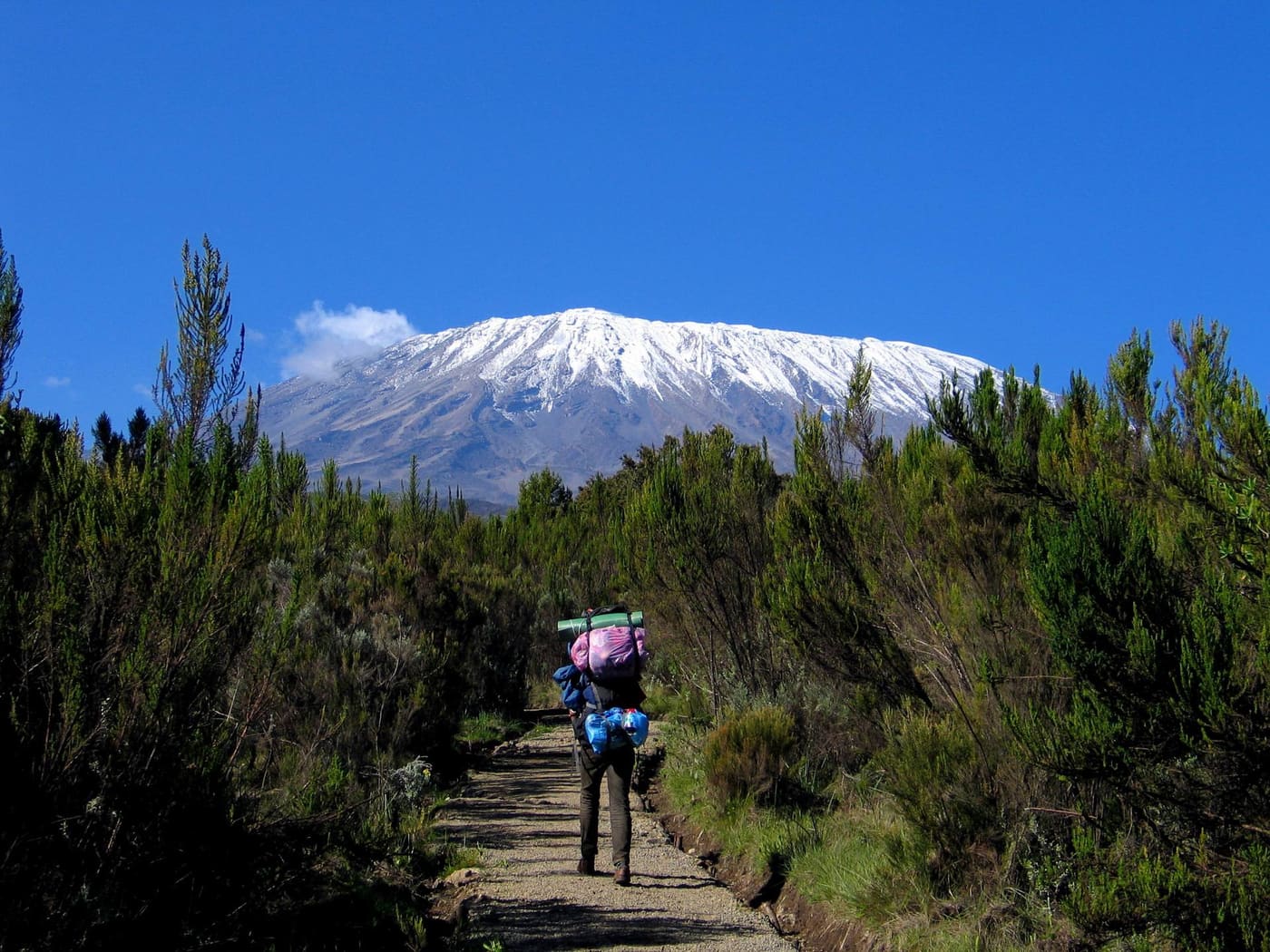
 Highest success rate – 5,895m
Route Overview
The Whiskey Route
Tanzania's most scenic and most popular Kilimanjaro route – a challenging six-day traverse through five ecological zones, past the Barranco Wall, and on to Uhuru Peak.
Challenging
6 Days
~85% Summit Rate
5 Nights Camping
The Kilimanjaro Machame Route – nicknamed the "Whiskey Route" – is regarded as the most beautiful and most rewarding path on the mountain. Unlike the more straightforward Marangu Route, Machame is a traverse: you ascend and descend via entirely different trails, experiencing a greater diversity of landscapes across Kilimanjaro's five distinct ecological zones.
The route passes through ancient rainforest, across the vast Shira Plateau at 3,700 metres, past the volcanic Lava Tower (known as the "Shark's Tooth"), and down into the dramatic Barranco Valley before the long push to the summit crater rim. The additional altitude gain and loss throughout the trek – particularly on Day 3 – provides valuable acclimatisation that significantly improves your summit success rate.
All camping equipment, meals, crew wages, and park fees are included. Our guides carry emergency oxygen, a pulse oximeter, and wilderness first-aid certification. Group size is capped at six climbers per guide to ensure personal attention throughout the climb.
D1
Machame Gate ? Machame Camp
1,800m ? 3,100m – ~5–7 hrs hiking
The drive from Moshi to the Mount Kilimanjaro National Park Gate takes about 50 minutes, passing through the village of Machame on the lower mountain slopes. After registration, you enter the park gate and walk through dense rainforest on a winding ridge trail. The canopy is spectacular – giant heather, ancient moss-draped trees, and the calls of Hartlaub's Turaco overhead. Lower sections of the trail can be muddy; gaiters and trekking poles are strongly recommended.
Rainforest
Colobus Monkey
Camp Dinner
D2
Machame Camp ? Shira Camp
3,100m ? 3,840m – ~4–6 hrs hiking
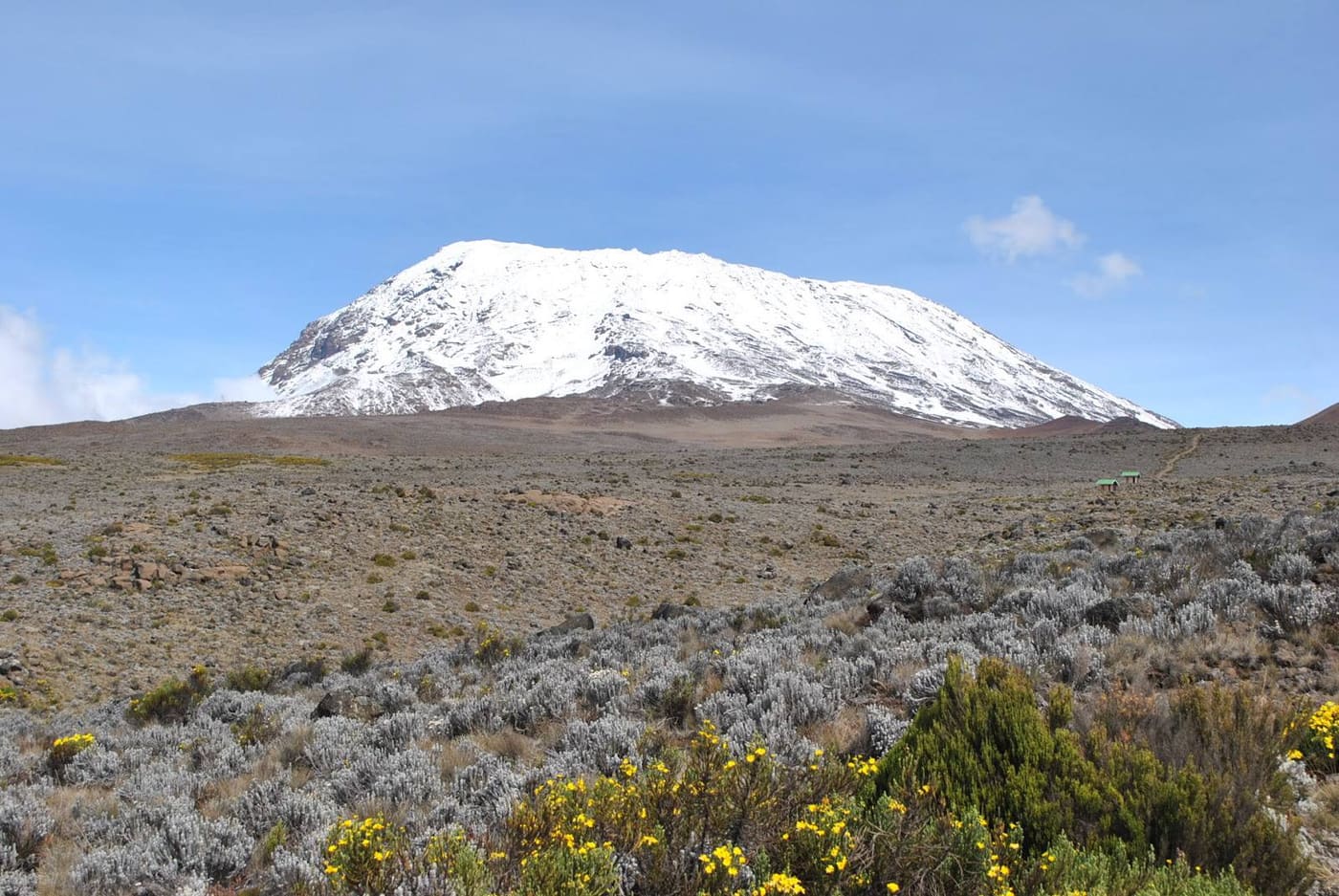
After breakfast, you leave the glades of the rainforest behind and continue on an ascending path. Crossing a small valley and climbing along a steep rocky ridge draped in heather and giant groundsel, you emerge onto the high moorland. The route turns west into a river gorge before opening onto the Shira Plateau – a vast alpine desert formed by the ancient collapsed caldera of Shira volcano. On clear days, views toward Mawenzi and Kibo are extraordinary.
Heathland
Shira Plateau
Giant Groundsel
D3
Shira Camp ? Lava Tower ? Barranco Camp
3,840m ? 4,600m ? 3,976m – ~7–8 hrs hiking
The most important acclimatisation day on the route. From the Shira Plateau you climb east toward Kibo, continuing southeast to the Lava Tower – a dramatic volcanic plug known locally as the "Shark's Tooth" – at 4,600m. After lunch at the tower, you descend steeply to the Barranco Valley. Although you end the day at nearly the same altitude you began, the high point at the Lava Tower triggers the acclimatisation response that will be critical for summit night. The Barranco Valley itself is stunning: giant lobelias and senecios – plants found almost nowhere else on Earth – fill the gorge floor.
Lava Tower 4,600m
Giant Lobelia
Acclimatisation Day
OPT
Optional Day (7-Day Trek): Barranco ? Karanga Camp
3,976m ? 4,035m – ~3–4 hrs
For those opting for the extended 7-day variation, this short day crosses the Barranco Wall and descends to the Karanga Valley campsite – providing an additional night of acclimatisation before the final push to Barafu. This extension increases summit success rates significantly and is recommended for first-time high-altitude trekkers.
Optional Upgrade
7-Day Version
D4
Barranco Camp ? Barafu Camp
3,976m ? 4,640m – ~6–7 hrs hiking
A challenging and memorable day. You begin by scaling the Barranco Wall – a near-vertical scramble that is more exposed than technical, with spectacular exposure views. Beyond the wall, the route winds through the Karanga Valley (lunch stop at 4,200m) and the junction connecting the Mweka descent trail, before the final climb to Barafu – the "high camp" from which all Machame summits are attempted. You have now completed the full South Circuit. The twin summits of Mawenzi and Kibo are visible from camp. Rest well; the alarm sounds at midnight.
Barranco Wall
Karanga Valley
High Camp 4,640m
D5
Summit Night ? Uhuru Peak ? Mweka Camp
4,640m ? 5,895m ? 3,100m – ~14–16 hrs total
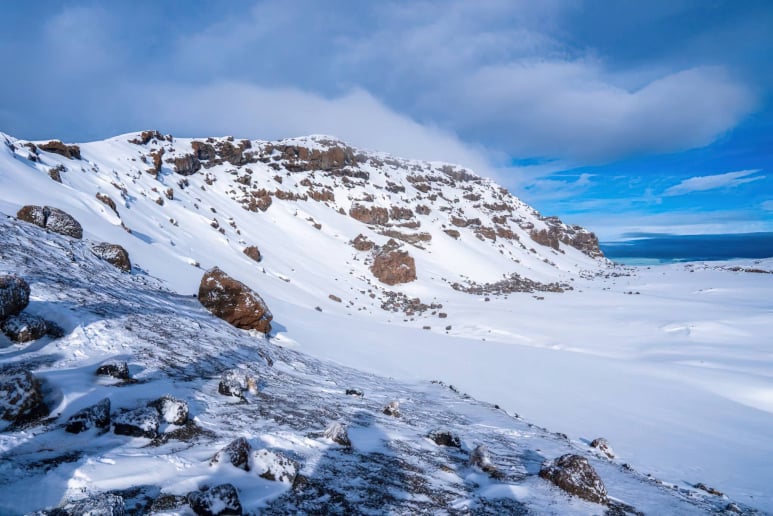
Departure begins at midnight or 1am, ascending northwest between the Rebmann and Ratzel glaciers through heavy scree in the dark. This is the most physically and mentally demanding section of the entire trek. At Stella Point (5,685m) on the crater rim you stop briefly – and if conditions allow, you will see the most magnificent sunrise of your life. From Stella Point it is one further hour across snow to Uhuru Peak at 5,895m: the highest point in Africa. After summit photographs, you descend directly to Mweka Camp, stopping at Barafu for lunch. Gaiters and trekking poles are essential for the loose scree descent.
Stella Point 5,685m
Uhuru Peak 5,895m
Summit Night
Sunrise on the Crater
D6
Mweka Camp ? Mweka Gate ? Moshi
3,100m ? 1,640m – ~3–4 hrs descent
After breakfast, you make the final descent through upper rainforest to the Mweka Park Gate, where summit certificates are presented to all those who reached Stella Point or above. At lower elevations the trail can be wet and muddy – gaiters help. A vehicle meets you at Mweka Village and transfers you back to your hotel in Moshi or Arusha. Don't forget to tip your guides and porters. Tonight: a well-earned celebration dinner.
Summit Certificates
Celebration Dinner
Transfer to Hotel
Travel Information
Getting to Kilimanjaro
This tour starts and ends in the Kilimanjaro region. Our team handles all ground logistics from the moment you arrive at the airport.
1
This tour starts and ends in the Kilimanjaro region, with the nearest international airport being Kilimanjaro International Airport (JRO), located approximately 40 km from Moshi and 50 km from Arusha. Most international flights transit through Dar es Salaam (DAR), Nairobi (NBO), or Addis Ababa (ADD).
2
Fly to or from Kilimanjaro Airport (JRO). Direct flights from Europe are available on KLM (Amsterdam) and Condor (Frankfurt). Check current prices and availability at your preferred flight booking platform.
3
Airport transfers to and from the start of the trek (Moshi / Arusha) can be arranged by Wild Gaze Safaris. Please advise your flight details at least 48 hours in advance. Transfer pricing is available on request.
4
Additional accommodation before or after the climb – in Moshi or Arusha – can be arranged at a range of price points. We work with trusted guesthouses and boutique lodges suited to trekkers arriving early or departing late.
What's Covered
Package Inclusions
Kilimanjaro National Park entrance and camping fees
Kilimanjaro Rescue Fee (mandatory government levy)
All meals during the trek (breakfast, lunch, dinner, snacks)
Purified drinking water and hot beverages throughout
Professional lead guide (10+ years Kilimanjaro experience)
All assistant guides, chefs, and porters (wages included)
High-quality four-season mountain tents
Sleeping bags and insulated sleeping mats (included on request)
Emergency oxygen and pulse oximeter carried by lead guide
All road transport to/from Moshi or Arusha to the gate
Summit certificate (for those reaching Stella Point or above)
All government taxes and VAT – no hidden charges